
The DROP TABLE command in SQL Server is used to remove a table from the database permanently. However, attempting to drop a non-existent table can result in execution errors. To prevent this, SQL Server 2016 introduced the DROP TABLE IF EXISTS command, which makes the process more efficient and error-free.
In this post, we’ll explore how to use DROP TABLE IF EXISTS in SQL Server and discuss alternative methods for older versions.
What is DROP TABLE IF EXISTS?
The DROP TABLE IF EXISTS command allows you to delete a table only if it exists in the database. It has been support since SQL Server 2016 (13.x), and helps prevent script execution errors and ensures smoother database management.
Example: Using Drop Table if Exists
Below is an example demonstrating the use of DROP TABLE IF EXISTS. The script first creates a table, then drops it using this command, and attempts to drop it again without errors:
-- Create a test table in SQL Server
CREATE TABLE demoTable (
    r_id INT,
    r_name VARCHAR(100),
    r_description VARCHAR(200)
);

-- Drop the table if it exists
DROP TABLE IF EXISTS demoTable;

-- Drop the table again (no error will occur)
DROP TABLE IF EXISTS demoTable;
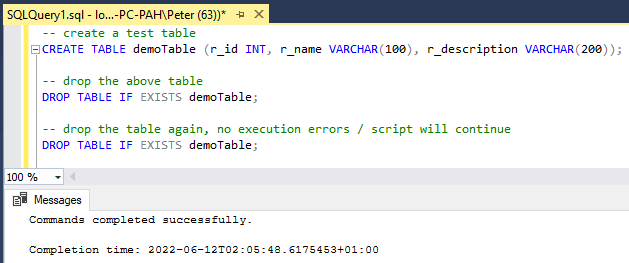
In this example:
1. We create a table named demoTable.
2. We execute DROP TABLE IF EXISTS demoTable to remove it.
3. Running the command again does not result in an error, since the table no longer exists.
Using DROP TABLE IF EXISTS in SQL Server 2014 or Below
If you are working with SQL Server 2014 or earlier, the DROP TABLE IF EXISTS command is not available. Instead, you need to check for the table’s existence using system tables before dropping it:
-- Check if the table exists before dropping it
IF EXISTS (SELECT 1 FROM sys.tables WHERE name = 'demoTable')
BEGIN
    DROP TABLE demoTable;
END
This method ensures compatibility with older SQL Server versions while still preventing errors when dropping non-existent tables.
Hope this was a useful guide for you!
What IF EXISTS Does Not Protect You From, Tested on SQL Server 2025
IF EXISTS suppresses exactly one failure, the table not being there. Every other reason a drop can fail still fails, and I ran these against a SQL Server 2025 instance to capture the real behaviour.
Foreign keys still block the drop. If another table references the one you are dropping, you get error 3726 regardless of IF EXISTS:
CREATE TABLE dbo.demo_parent (id INT PRIMARY KEY);
CREATE TABLE dbo.demo_child (id INT REFERENCES dbo.demo_parent(id));

DROP TABLE IF EXISTS dbo.demo_parent;
-- Msg 3726: Could not drop object 'dbo.demo_parent' because it is
-- referenced by a FOREIGN KEY constraint.
A view with the same name still errors. DROP TABLE checks what the object actually is, so pointing it at a view raises error 3705, “Cannot use DROP TABLE with ‘dbo.demo_view’ because ‘dbo.demo_view’ is a view. Use DROP VIEW.” I confirmed the view survives the attempt untouched. And permissions are unchanged too, you still need ALTER on the schema or CONTROL on the table, so IF EXISTS in a deployment script does not make the script runnable by an account that could not drop the table anyway.
Multiple Tables and Temp Tables
One statement can drop several tables, and with foreign keys involved the order inside the list matters. This works because the child goes first:
-- Child first, then parent, one statement, no errors
DROP TABLE IF EXISTS dbo.demo_child, dbo.demo_parent;
Temp tables work with the same syntax, and running it twice in a row is silent both times, which is exactly what you want at the top of a stored procedure or an ad hoc script:
DROP TABLE IF EXISTS #work;
CREATE TABLE #work (id INT);
If you find yourself creating a lot of temp tables in procedures, it is worth knowing when a table variable is the better call, and I wrote up the optimizer-level differences on sqldba.blog in Table Variables vs Temp Tables in SQL Server.
A Flaw in the Old sys.tables Pattern
The pre-2016 workaround shown above has a quiet weakness: it checks name only, so it is schema-blind. If sales.demoTable exists but dbo.demoTable does not, the IF EXISTS check passes and the unqualified DROP TABLE demoTable then resolves against your default schema and fails, or worse, a later variant drops a table you did not mean. If you are stuck on an older version, the safer pattern schema-qualifies both the check and the drop:
-- Schema-qualified check and drop for SQL Server 2014 and below
IF OBJECT_ID('dbo.demoTable', 'U') IS NOT NULL
BEGIN
    DROP TABLE dbo.demoTable;
END
The 'U' argument restricts the match to user tables, which also stops a view with the same name from sneaking through the check. I verified on 2025 that OBJECT_ID returns NULL for a missing table, so the pattern behaves the same today, meaning scripts written this way stay portable from SQL Server 2014 up to current versions.
Leave a Reply